The Arts We Teach and Study
Jiyushin-ryu AikiBudo
The Jiyushin-ryu AikiBudo that we practice at the Renshinkan is a synthesis of the teachings of Kano, Ueshiba, and Tomiki as handed down to us by our teacher C. E. Clark. Clark sensei has extensive experience not only in Judo and Aikido, but also in various other arts, all of which have influenced our AikiBudo to varying degrees.
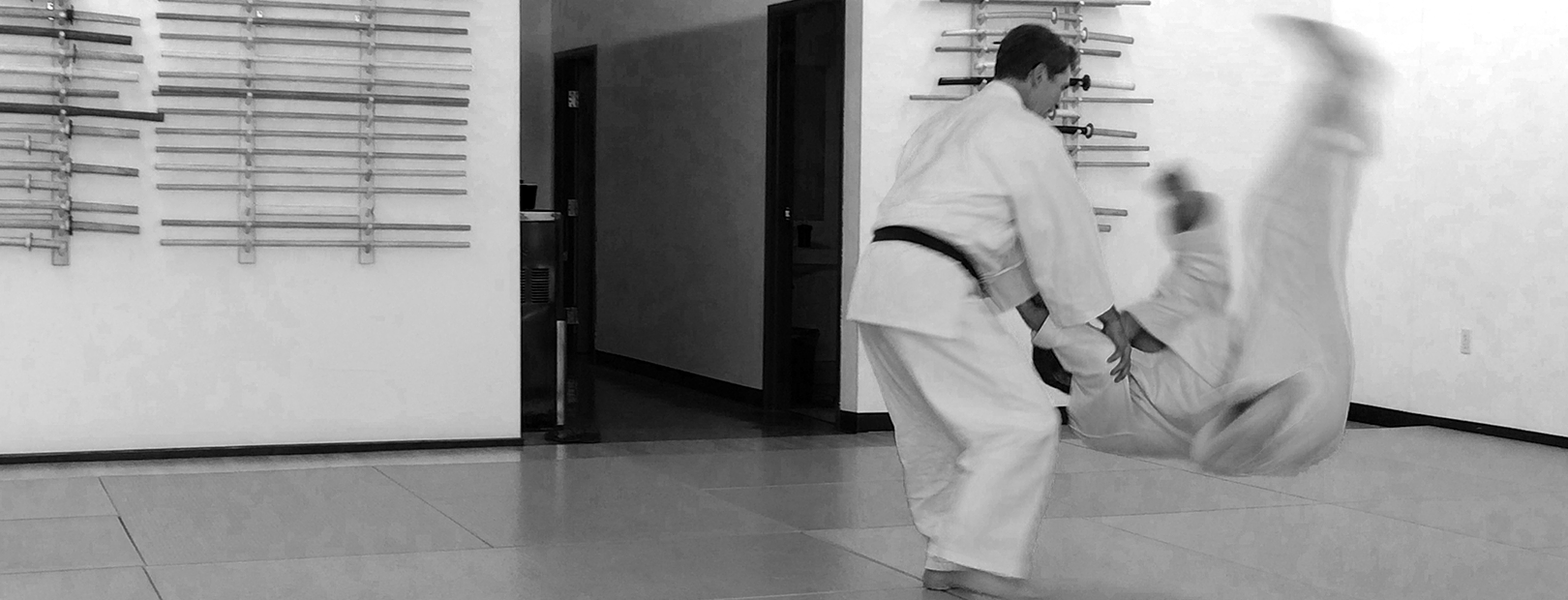
Jiyushin-ryu AikiBudo comprises throwing and joint-locking techniques, ground work, striking, and weaponry. What we do isn’t quite Judo, nor is it quite Aikido, but it shares elements of both. Rather than attempt to explain it here, we recommend you come in, watch several classes, ask questions of our senior dojo members, and experience what we do for yourself.
If a technique will not work for the smallest person against the largest person with minimum force and speed, it is not being practiced properly or it is not a viable technique. Large, fast, and strong people should not rely on these assets because there is always someone bigger, faster, and stronger. We know that we all are less capable of strong athletic skills as we grow older. We must practice principles that do not require great strength and acrobatic skills while young in order to attain the skill necessary to overcome hardness with softness when we are older.
— C. E. Clark, Jiyushinkai Founder
Shinto Muso-ryu jo
Shinto Muso-ryu jo is said to be the oldest style for using a stick (jo) in combat in Japan. It was founded in the early 17th century by Muso Gonnosuke Katsuyoshi, an exponent of Tenshin Shoden Katori Shinto-ryu. The jo is a staff-like weapon, 50 1/4″ x 7/8″.
There are a total of 64 techniques in Shinto Muso-ryu jo divided into a number of sets. Training is systematic and develops the exponent’s technical skills and psychological abilities, from body movement and weapons handling to the proper use of timing, targeting, and distancing.
Also included in the curriculum are twelve techniques of swordsmanship called Shinto-ryu kenjutsu.
There are four levels of recognition in Shinto Muso-ryu jo. They are okuiri-sho, sho-mokuroku, go-mokuroku, and menkyo kaiden.
Students in the Renshinkan study Shinto Muso-ryu jo under the direct transmission of Phil Relnick sensei, Menkyo Kaiden.